Types of Ratchet Sockets and Their Uses
November. 17, 2026
Two sockets marked 13 mm can fit the same nut and still solve different problems. A standard socket may fit where space is tight. A deep socket gives a protruding stud room inside the tool so the socket can reach the nut. Other fasteners need a different shape altogether, such as an E-Torx socket for an external star head.
Start by checking three things: the fastener profile and size, the clearance around it, and the square drive on your ratchet.
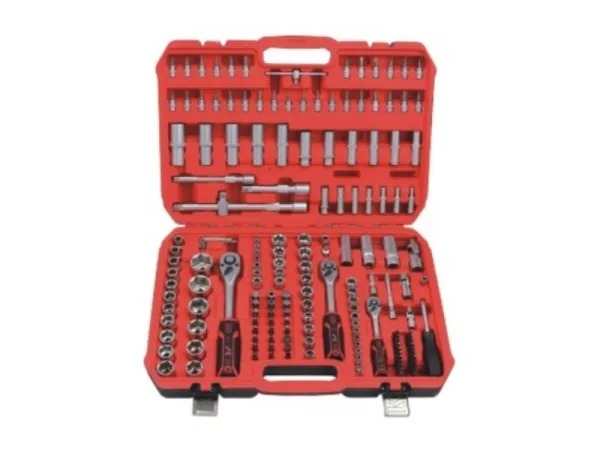
Ratchet Socket Types at a Glance
| Socket type | When to use it |
|---|---|
| Standard (shallow) | Accessible nuts and bolt heads, especially where space above the fastener is limited. |
| Deep | Nuts on protruding studs or fasteners that need extra socket reach. |
| E-Torx | Fasteners with a raised, six-lobed external star head. |
| Spark plug | Removing or installing spark plugs with the specified hex size and suitable reach. |
| Bit socket | Turning fasteners with a recessed drive, such as internal hex or Torx. |
What Each Socket Does
Standard and deep sockets
A standard socket is the everyday choice for an exposed hex nut or bolt head. Its shorter body helps when a bracket or panel limits room above the fastener. A deep socket provides more internal clearance for a long stud. If a shallow socket bottoms out before its opening fully seats on the nut, try a deep socket of the same opening size. If an obstruction simply keeps the ratchet handle too far away, an extension can add reach between the ratchet and socket.
E-Torx and bit sockets
An E-Torx socket fits over a raised star-shaped head. Its size starts with E, as in E10. A Torx bit socket marked T, such as T30, has a projecting bit that goes into a recessed star-shaped drive. Check the fastener before choosing the profile. The P51023 set includes both E-series sockets and T-series bit sockets.
Spark plug sockets
A spark plug socket reaches the hex on the plug while leaving room for the ceramic insulator. Some designs use a magnet or insert to hold the plug as it moves in or out of the well. Check the plug’s specified hex size and the clearance inside the well. The P51023 set lists 16 mm and 21 mm spark plug sockets in 1/2 in. drive and an 18 mm socket in 3/8 in. drive.
Drive Size and Socket Opening
The square drive tells you which ratchet the socket fits. The opening tells you which fastener it fits. A 3/8 in. drive × 13 mm socket fits a 3/8 in. ratchet and a 13 mm hex head, measured across its flats. An inch-based drive can pair with a metric socket opening.
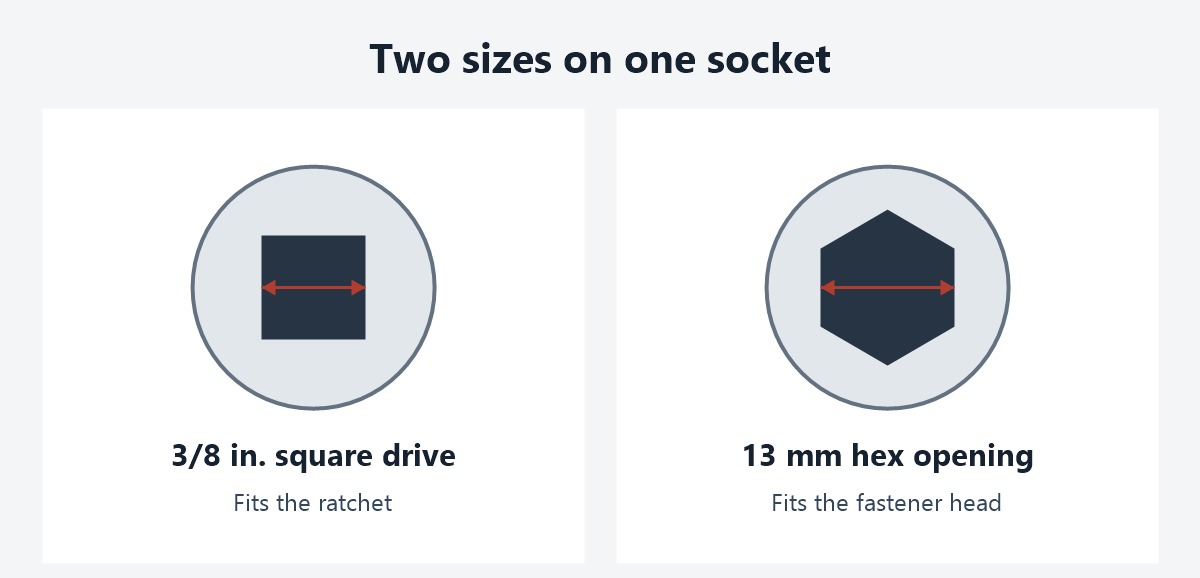
Common square drives include 1/4 in. for compact setups and smaller fasteners, 3/8 in. for general service, and 1/2 in. for larger fasteners and heavier work. When using a powered impact wrench, choose sockets and any adapters explicitly rated for impact use. Check the tool rating separately from the square drive size.
Reading a Socket Set’s Contents List
Check the opening sizes, available depths, and included ratchets for each drive. A piece count can include bits, extension bars, and adapters. The contents list shows which sockets you actually get. For example, the PTATOOLS 25-piece 1/4 in. metric set has a single drive format, while the P51023 171-piece set covers three drive sizes and adds specialty profiles.
For wholesale or OEM sourcing, list the drive sizes, metric or inch openings, and specialty sockets your customers need. Include any packaging requirements when requesting a quote. Browse PTATOOLS socket sets.
Related Categories
1/4 in. drive standard sockets – shallow hex sockets for accessible fasteners.
1/4 in. drive deep sockets – extra internal clearance for protruding studs.
E-type sockets in 1/4, 3/8 and 1/2 in. drive – external star sockets across three drive sizes.
All socket sets – 1/4, 3/8 and 1/2 in. drive sets in metric and inch openings.