Mounted Point Types, Shapes, and Uses
November. 17, 2026
Mounted points are compact abrasive tools designed for precision grinding in areas that larger wheels cannot easily reach. Understanding their abrasive types, shapes, and applications can help you choose the right point for your workpiece and finishing requirements.
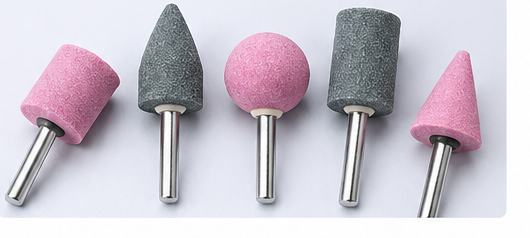
What Are Mounted Points?
Mounted points are small abrasive grinding heads attached to a metal shank. The shank fits into a compatible die grinder, straight grinder, or other rotary tool. They are often used for detail work, internal grinding, deburring, edge blending, and surface finishing.
Because mounted points are available in different abrasive grains, bond structures, sizes, and shapes, they can be selected for a wide range of materials and working conditions. Their compact design makes them especially useful for narrow openings, curved surfaces, and other hard-to-reach areas.
Important: A mounted point is not a one-size-fits-all abrasive. The correct choice depends on the workpiece material, the operation, the required finish, and the specifications of the rotary tool.
Common Types of Mounted Points
Mounted points are commonly classified by their abrasive grain and construction. The following are several abrasive options used in grinding applications. Availability and suitability vary by manufacturer and product specification.
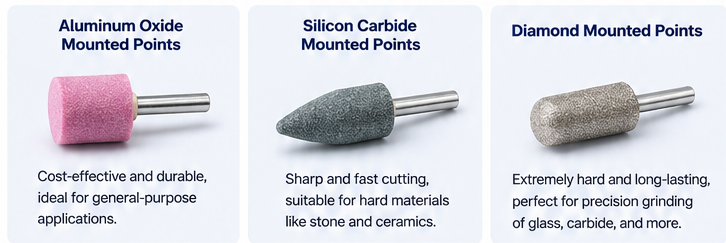
Aluminum Oxide Mounted Points
Aluminum oxide is widely used for grinding ferrous metals, including many types of steel and iron. It is a common choice for general-purpose grinding, shaping, and deburring.
Silicon Carbide Mounted Points
Silicon carbide is a sharp, hard abrasive often selected for non-ferrous metals, cast iron, stone, glass, and other materials where the abrasive grade and bond are suitable.
Diamond Mounted Points
Diamond abrasive points are used for precision work on very hard, brittle, or abrasive materials, such as ceramics, glass, carbide, and stone. They are generally selected for applications requiring a superabrasive.
CBN Mounted Points
Cubic boron nitride (CBN) points are used for grinding hard ferrous materials, including hardened steels. They are a specialist option for applications that call for a superabrasive rather than a conventional abrasive grain.
Conventional mounted points are often made with vitrified or resin bonds, depending on the intended application. Diamond and CBN products use specific bonding systems designed to hold the superabrasive grains. Always check the product specification before selecting a point.
Popular Mounted Point Shapes
The shape of a mounted point determines how it contacts the workpiece and which areas it can reach. Common shapes include:

- Cylindrical: Suitable for flat surfaces, shoulders, and general surface grinding.
- Cylindrical with a rounded end: Useful for working along edges, contours, and slightly curved surfaces.
- Conical: Designed for angled surfaces, corners, and narrow spaces.
- Tree: A tapered profile that can reach grooves, slots, and internal corners.
- Ball or spherical: Useful for curved surfaces, rounded cavities, and contour work.
- Oval: Suitable for blending and finishing curved or contoured areas.
- Flame: A pointed, curved profile for detailed work in grooves and hard-to-reach areas.
- Disc: Useful for working on narrow edges and surfaces where a thin profile is needed.
Shape names and dimensions can differ between product ranges. When ordering, refer to the manufacturer's drawings, dimensions, and shape codes rather than relying on the name alone.
What Are Mounted Points Used For?
Mounted points are used in a range of manufacturing, maintenance, and metalworking operations. Typical applications include:
Precision Grinding
Grinding small areas, internal surfaces, edges, and detailed features on metal components where larger abrasive wheels may not fit.
Deburring
Removing burrs and sharp edges left by drilling, milling, cutting, casting, or other machining processes.
Weld and Die Finishing
Blending selected weld areas, refining die surfaces, and finishing small or complex metal parts. Choose a point suited to the base material and required finish.
Polishing and Surface Preparation
Preparing localized areas for subsequent finishing operations. The abrasive type and grit should match the desired surface condition.

How to Choose the Right Mounted Point
Choosing the right mounted point helps improve grinding results, process consistency, and tool life. Consider these factors before placing an order or starting a job.
1. Identify the Workpiece Material
Start with the material being processed. Steel, stainless steel, cast iron, non-ferrous metals, carbide, glass, and ceramics may require different abrasive grains and bond specifications.
2. Match the Shape to the Operation
Choose a profile that can reach the target area and provide the required contact. Cylindrical shapes are useful for accessible flat areas, while conical, tree, and ball shapes can help with corners, grooves, and contours.
3. Select the Appropriate Size
Consider the diameter, length, and shank dimensions. The point should fit the working area, and its shank must be compatible with the tool collet. Do not use a point that requires forcing or makes the tool unstable.
4. Choose the Right Grit and Bond
Coarser grits are generally used for faster material removal, while finer grits are used when a smoother finish is required. Bond type and hardness also affect how the abrasive performs. Follow the product manufacturer's recommendations for the material and operation.
5. Check Tool Compatibility and Operating Speed
Confirm the shank size, tool capacity, and maximum operating speed marked on the mounted point. The operating speed must not exceed the product's rated maximum RPM. Follow the tool and abrasive manufacturer's instructions.
Safety Tips for Using Mounted Points
Mounted points rotate at high speeds, so correct handling is essential. Follow these basic precautions:
- Inspect the point before use. Do not use products with cracks, damage, or other visible defects.
- Make sure the shank is correctly and securely held in a compatible collet.
- Never exceed the maximum operating speed marked by the manufacturer.
- Wear suitable eye and face protection, hearing protection, and other PPE required by the task.
- Keep hands, clothing, and loose materials away from the rotating point.
- Use controlled pressure. Excessive force can damage the abrasive point or workpiece.
- Follow the manufacturer's guidance on mounting, testing, cooling, and storage.
Mounted Points for Industrial and Professional Use
For manufacturers, distributors, and professional users, selecting a consistent mounted point range is important for repeatable grinding and finishing operations. When evaluating products for regular production or wholesale supply, review the abrasive type, shape, dimensions, shank size, grit, bond, packaging, and applicable product standards.
If you are sourcing mounted points for your business, provide your supplier with the workpiece material, application, preferred shape and dimensions, tool specifications, and required finish. These details make it easier to identify a suitable product and compare options accurately.
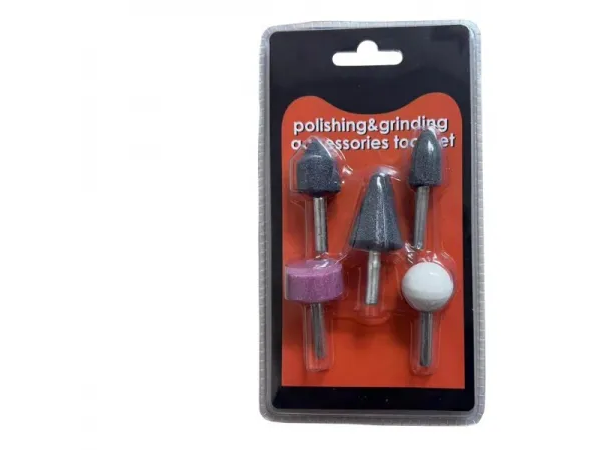
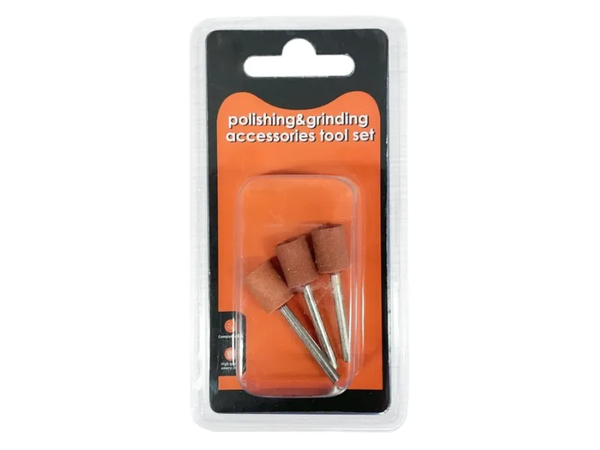
PTATOOLS supplies mounted points as single sets and as larger grinding and polishing accessory kits:
- 3Pcs Mounted Point Set – 3.17mm shank, aluminum oxide.
- 5Pcs Mounted Point – aluminum oxide and silicon carbide points.
- 19Pcs Grinding Accessories Set
- 33Pcs Grinding Accessories Set
- 48Pcs Grinding Accessories Set
- 71Pcs Grinding Accessories Set
Conclusion
Mounted points are versatile abrasive tools for precision grinding, deburring, and surface finishing. Their performance depends on choosing the right abrasive, shape, size, grit, and bond for the job. By matching the mounted point to the workpiece and rotary tool—and following the manufacturer's safety instructions—you can achieve more consistent results in detailed grinding applications.
Related Categories
- Mounted points – aluminum oxide and silicon carbide points in a range of shapes, plus grinding and polishing accessory sets.
- Grinding wheels – larger bonded abrasives for surface, edge and weld grinding.
- Tungsten carbide burrs – shaped carbide cutters in cylindrical, ball, cone and tree profiles for heavier stock removal.
- Sanding and polishing accessories – flap discs, sanding discs, polishing pads and wire brushes for the finishing steps.
Further Reading
- The versatility of carbide burr bits – when a carbide burr is the better choice for deburring and shaping.
- Angle grinder disc types – matching the disc to the material and the operation.
- Cut-off wheel vs grinding wheel – two abrasive wheels that are not interchangeable.
- Polishing pad color and density chart – reading pad color, foam density and cut level before the final polish.